
PART 1 – SUSTAINABLE PRACTICES ADOPTED IN WWF PARTNER RESTAURANTS

In late 2018, the World Wide Fund for Nature (WWF) Philippines commissioned a study to determine the benefits and costs of integrating sustainable consumption and production (SCP) principles in the restaurant business. The aim was to build a case for the adoption of SCP practices in restaurants if they are found to be beneficial, viable and rewarding.
The experiences of the WWF Philippines’ partner food service establishments served as key sources of information for the study. These restaurants were in various stages of sustainability practices – those with low awareness of SCP and only starting to apply SCP principles in their operations; those which were aware of the importance of SCP and were in the process of carrying them out; and those where the SCP principles were integrated in their business models.
The study not only looked at the financial benefits and costs, which impacts directly on the profitability of individual establishments, but also on the economic, social, and environmental (for simplicity, we call these “economic”) benefits and costs, which impacts on the society-at-large. Hence, the analysis also considers the contribution of SCP for the betterment of society.
22 practices dominated in the following areas of sustainability: energy (electricity, 3
practices), water (3), food waste (8), non-food/general waste (3), local sourcing (3), and
other SCP (1).

It was found that in the WWF Philippines’ partner establishments, 22 practices dominated in the following areas of sustainability: energy (electricity, 3 practices), water (3), food waste (8), non- food/general waste (3), local sourcing (3), and other SCP (1). (See box below)
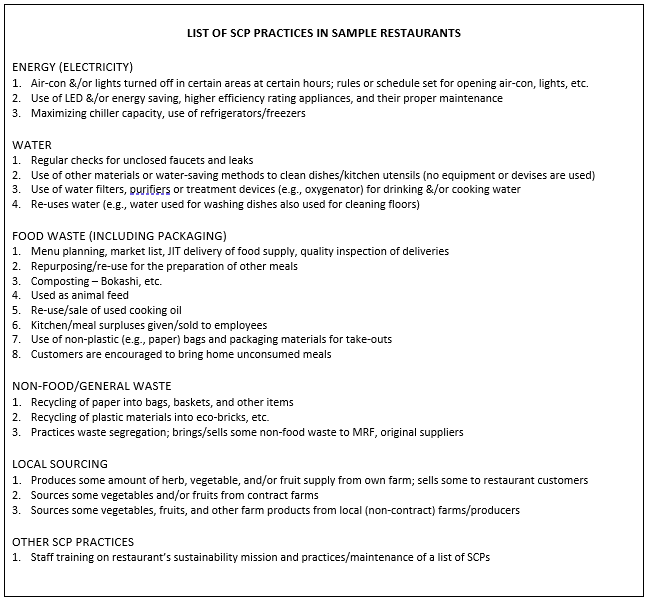
As expected, the food service establishments with the highest level of awareness and adoption of SCP principles recorded half of the use of all the practices observed.
But even in restaurants with low awareness of SCP, sustainable practices existed. This suggested that they were unwittingly integrating some SCP principles into their operations presumably for cost reduction. They were using of energy-saving or energy efficient lights and appliances.
Other popular SCP practices were meal planning/JIT delivery of food supply; repurposing of unused food supply/unconsumed meals for the preparation of other meals; composting, use of water filters, purifiers, or treatment devices; and production of some amount of herb, vegetable, and/or fruit from own farm or garden.
The next step was running cost-benefit analyses to determine if adopting these practices was indeed financially worthwhile and economically and socially beneficial. This is the subject of Part 2 of this article.
About this Research
These notes were drawn from the background research and results of the study led by the author for WWF Philippines entitled “The Cost-Benefit Study of Integrating Sustainable Consumption and Production into Business Operations of Food Service Establishments.” The study was completed in May 2021. Part 1 identified the common sustainable practices adopted and set the baseline for the cost-benefit analysis of some of these practices in Philippine restaurants.
 Bing Icamina | Economist & Management Consultant