
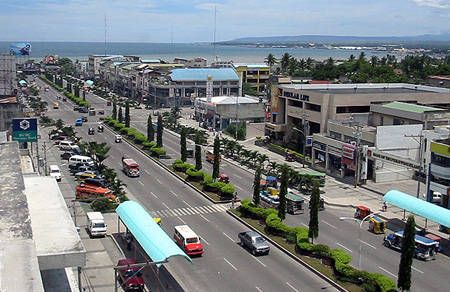
General Santos City was a boom town in the 1980’s, a city built on tuna among other marine products and has earned the reputation of being “the tuna capital of the Philippines.” The city’s growth continues up to today, although briefly disrupted by the natural and man-made disasters in 2019 and the punishing lockdowns imposed at the height of the COVID-19 pandemic in 2020-2021.
Amidst this glowing trends, signs of urban decay have become apparent. What used to be Gensan’s key social, economic, and cultural district – where its central public market, major recreational park and beach, and some institutional centers once stood proudly – has sadly fallen into disrepair and disarray. This has created a huge dampener on the city government’s plan to attract investments into this area. The district consists of Dadiangas East, West and South, and parts of adjacent barangays on the east such as Bula, bounded by Silway River on the west and the picturesque Sarangani Bay on the south. Several reasons have been cited for the decline of this old central business district (CBD).
Several reasons have been cited for the decline of this old central business district: transfer of the fish port complex to another location; development of road infrastructure and traffic management; emergence of modern shopping malls elsewhere.
Several reasons have been cited for the decline of this old central business district: transfer of the fish port complex to another location; development of road infrastructure and traffic management; emergence of modern shopping malls elsewhere.
When the fish port complex was transferred to another location, the CBD lost the opportunities from the tuna value chain – such as trading, processing, and packaging – other than retail selling. The development of road infrastructure elsewhere and traffic management also made access to the beach difficult, hence losing a large chunk of visitors and locals bringing their families to the beach for weekend bonding. With less and less people visiting, part of the beach became a haven for informal settlers escaping conflict ridden areas in Mindanao.
Finally, the emergence of sparkling, modern shopping malls elsewhere in the city led to a massive shift in demographics and further waning attractiveness of the old CBD.
In 2019, the National Economic and Development Authority (NEDA) commissioned a multidisciplinary team of experts and specialists to draw up a master plan for the sustainable urban infrastructure development of General Santos City. This is part of NEDA’s broader initiative of supporting the SOCCSKSARGEN (Region XII) Sustainable Agri-Industrial Development Strategy (SAIDS).
Under the General Santos City master plan, one of the tasks assigned to the team was to conduct business case/pre-feasibility studies for top priority programs/activities/projects (PAPs). Five PAPs have been selected for this purpose, and one of them was the Urban Coastal Redevelopment Program. Which essentially aims to revitalize the old CBD, restore its old glory, and raise its investment value.
This is an ambitious goal, given the area involved and, obviously, the amount required. The team responded to this challenge by adopting a modest approach: redevelop a strategic piece of property within the CBD that will create a catalyzer for the revival of the entire district. A 2.3-kilometer coastal strip from the mouth of Silway River to Barangay Bula with a total area of nearly 35 hectares was targeted for redevelopment.
About this Research
This note summarizes the situation analysis and rationale conducted by a team commissioned by the National Economic Development Authority (NEDA) in 2019 for the proposed redevelopment of the old General Santos CBD under the Urban Coastal Redevelopment Program. Part 2 discusses the
redevelopment plan.
 Bing Icamina | Economist & Management Consultant